Home › Blog
What Is Corporate Social Responsibility?
Corporate social responsibility is how a company structures its policies, governance and reporting so that its commercial activity produces decent outcomes for employees, customers, suppliers, communities and the environment, alongside profit. It is not a statutory term in UK law, which is why it means slightly different things in different companies. It is also not optional in the way people assume: several of its component parts are legal duties with penalties attached.
The four layers, and why the order matters
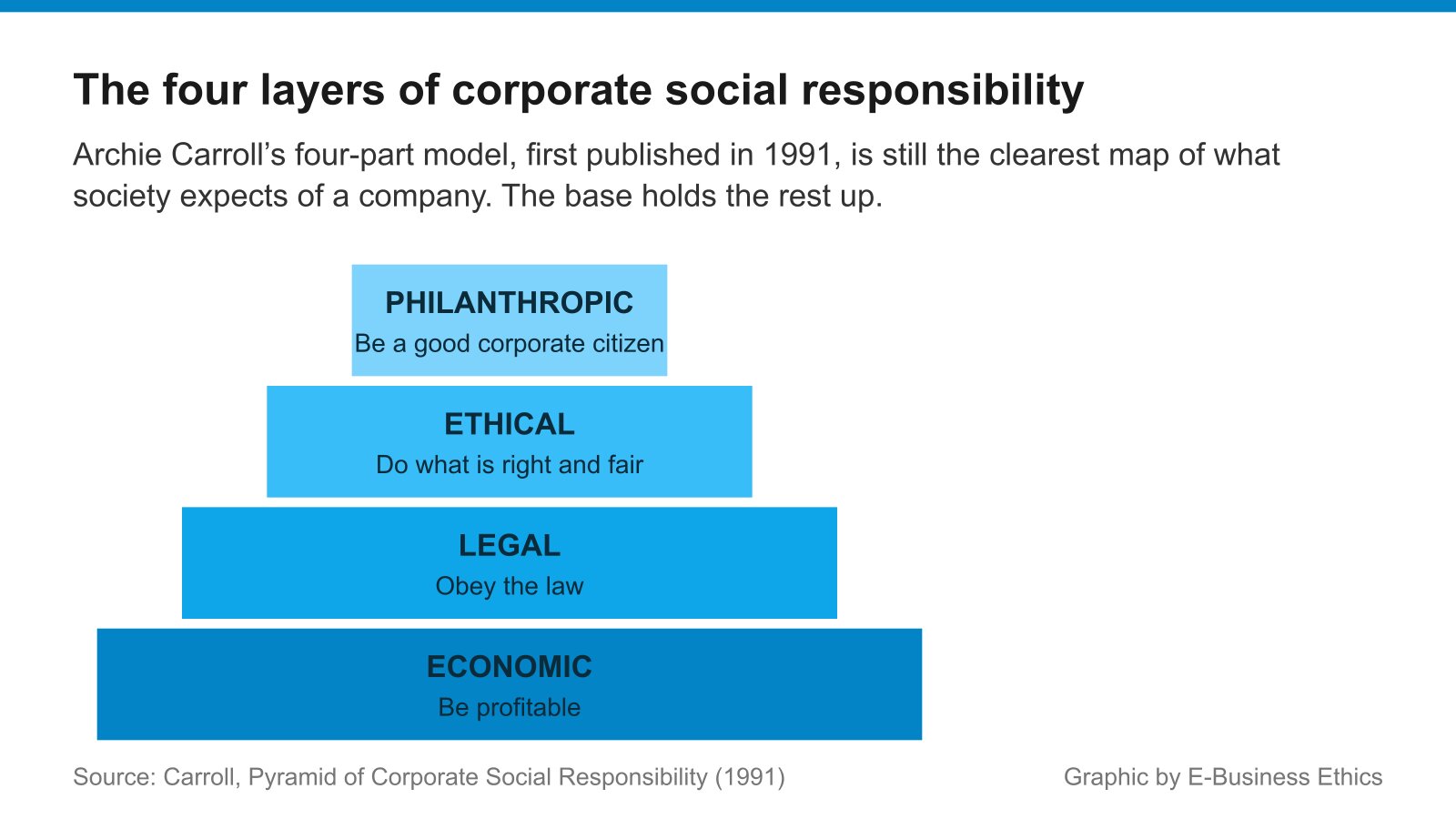
The most durable framework is Archie Carroll's, published in 1991 and still the clearest map of what society expects of a firm. It has four layers.
- Economic: be profitable. The base. A business that does not survive helps nobody. Everything above depends on this layer holding.
- Legal: obey the law. Compliance is not a CSR achievement, it is the entry fee. Employment law, health and safety, consumer law, environmental permits, tax.
- Ethical: do what is right and fair. The interesting layer. Things society expects but has not legislated: not squeezing a small supplier's payment terms because you can, not designing a product to be hard to cancel.
- Philanthropic: be a good corporate citizen. Discretionary contribution of money, time, skills or facilities. Real, valued, and the least important of the four despite getting the most photographs.
The order is the point. A company that runs a food bank drive while paying suppliers in 90 days has the top layer without the one below it. Auditors and journalists notice.
Where UK law already makes it compulsory
CSR sits outside legislation as a concept, but a surprising amount of it has been pulled inside.
Section 172, Companies Act 2006
Directors have a duty to promote the success of the company for the benefit of its members, and in doing so must have regard to a defined list: the likely long-term consequences of decisions, the interests of employees, the need to foster business relationships with suppliers and customers, the impact of operations on the community and the environment, the desirability of maintaining a reputation for high standards of business conduct, and the need to act fairly between members. Large companies must publish a section 172 statement explaining how the board did this.
Reporting duties that follow size
- Streamlined Energy and Carbon Reporting: large UK companies and LLPs disclose energy use, emissions and efficiency action in their annual report.
- Modern slavery statement: commercial organisations over the turnover threshold must publish an annual statement on slavery and human trafficking in their business and supply chains.
- Gender pay gap reporting: employers with 250 or more staff publish their figures annually.
None of these is branded CSR. All of them are CSR, made mandatory and given a deadline.
CSR, ESG and sustainability
These three get used interchangeably and should not be. CSR is the behaviour: what the company chooses to do. ESG is the measurement framework investors and lenders use to compare companies on environmental, social and governance performance. Sustainability is narrower again and usually means environmental impact over time. A company can have an articulate CSR narrative and a poor ESG score, because one is self-written and the other is assessed. We unpick the differences in ESG vs CSR vs sustainability.
What good looks like in a real company
Strip away the language and effective corporate responsibility has five features.
- It is material. A haulier's responsibility agenda is about emissions, driver welfare and road safety. A software firm's is about data, energy use and accessibility. Copying someone else's priorities is the commonest failure.
- It is owned at board level. Not a committee, a named director with the budget.
- It has numbers with dates. A baseline, a target, an interim milestone. Without those there is nothing to be held to.
- It includes the supply chain. Most of a company's social and environmental footprint sits outside its own walls. So does most of its risk.
- It reports the failures. A report where every target was met is a report nobody believes.
If you want an external standard to test yourself against, B Corp certification is the most demanding commonly used route in the UK; our guide to what B Corp certification costs covers what that involves. For a broader programme view, see our corporate sustainability guide.
The business case, told honestly
CSR is sold as a growth lever. It is more dependable as a risk and cost lever. The measurable returns in most companies come from recruitment and retention, fewer regulatory interventions, cheaper capital and access to procurement frameworks that now screen for carbon reporting, modern slavery compliance and payment practices. Public procurement in particular has quietly made parts of CSR a precondition of bidding.
There is a reputational return too, but it is asymmetric: doing it well rarely produces a surge in sales, while doing it badly and being found out produces an immediate and expensive problem.
Common failure modes
- Greenwashing. Claims that outrun the evidence. The regulatory tolerance for this has narrowed sharply.
- The annexed report. A glossy CSR section bolted onto a strategy it does not touch.
- Philanthropy as cover. Donations offered in place of fixing conditions inside the business.
- Measuring inputs. Counting volunteering hours rather than what changed as a result.
Frequently Asked Questions
What is corporate social responsibility in simple terms?
It is the idea that a company owes something to the people it affects, not only to its shareholders. In practice it means running the business so that employees, customers, suppliers, the community and the environment come out of the relationship no worse, and ideally better.
Is CSR a legal requirement in the UK?
CSR as a whole is not a statutory term, so there is no single law requiring it. Several of its components are compulsory: directors must have regard to employees, suppliers, the community and the environment under section 172 of the Companies Act 2006, and larger companies face mandatory energy, carbon, modern slavery and gender pay reporting.
What are the four types of CSR?
Archie Carroll's 1991 model sets out four: economic, be profitable; legal, obey the law; ethical, do what is right and fair beyond the law; and philanthropic or discretionary, contribute resources to the community. They stack, with the economic layer at the base.
What is the difference between CSR and ESG?
CSR is the older, broader idea about how a company behaves. ESG is the measurement and disclosure framework investors use to score environmental, social and governance performance. CSR is largely self-defined; ESG exists because capital markets needed something comparable between companies.
Does CSR actually make money?
It is more reliable at protecting money than making it. The clearest commercial returns come from lower staff turnover, easier recruitment, fewer regulatory problems and better access to procurement, all of which are cost avoidance. Treating CSR as a revenue line usually produces the shallow version.
How do you tell real CSR from greenwashing?
Look for numbers, a baseline and a date. A real commitment says what will change, by how much, against what starting point, by when, and reports the misses as well as the hits. Marketing says a company is passionate about sustainability and shows a photograph of a wind turbine.
Sources
- Companies Act 2006, section 172: the duty to promote the success of the company and the factors directors must have regard to.
- GOV.UK, environmental reporting guidelines: Streamlined Energy and Carbon Reporting requirements for large companies.
- GOV.UK, publish an annual modern slavery statement: who must report and what the statement has to cover.